

October 15, 2026 | Real Estate Advice
Equity Unlocked: How Down sizers Can Fund Retirement, Travel and a Child’s First Home

We are well into fall, and the colder weather is here. The leaves are piling up and the furnace is running again. Soon, the snow shovel comes out too. For many homeowners in Burlington, Oakville and Hamilton, these seasonal changes are a reminder that it’s time to start enjoying life more and working on maintenance less.
You raised your family in a beautiful home, but your needs have changed, the upkeep never ends and those long-awaited travel plans are still waiting.
Here is the good news. Your home has likely built significant equity over the decades. With the right plan, that equity can fund a lower-maintenance lifestyle, a stronger retirement and more time away. It can even help your children buy their first home. In this guide, we walk through exactly how it works, using real local numbers.
Why This Winter Is the Moment to Plan Your Equity Move
Many downsizers wait for a perfect moment. Unfortunately, that moment rarely announces itself. Instead, the decision often gets made in a rush after a fall on the ice, a costly roof repair or a health scare.
Planning now puts you in control. You can decide on timing, budget and lifestyle while you still have choices. Furthermore, a calm plan protects your equity from the costly mistakes of a hurried sale.
Ask yourself a few honest questions this season:
- Do we use every room in our home, or do we heat and clean space we rarely enter?
- How much time do we spend on yard work, snow removal and repairs each year?
- Would we travel more if we could lock the door and leave?
- Is our retirement savings as strong as we would like it to be?
If those answers point toward change, it is worth seeing what your equity could do.
What Your Home Is Worth in Today’s Market
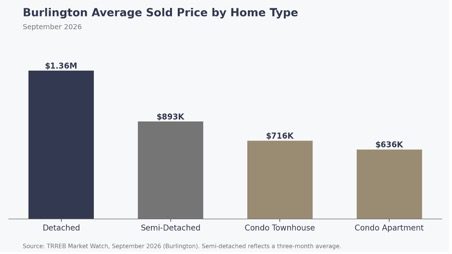
Detached homes remain the most valuable property type in our area. In September 2026, the average detached home in Burlington sold for about $1.36 million. In contrast, condo townhouses averaged about $716,000, and condo apartments averaged about $636,000.
That gap is where your opportunity lives. When you sell a detached home and buy a smaller, low-maintenance property, the difference becomes usable equity. Many of our clients own homes valued at $1.5 million or more, especially in established Burlington and Oakville neighbourhoods.
Alt text: Equity gap chart showing Burlington average sold prices by home type in September 2026
Sell High, Buy Smart: The Market Works in Your Favour
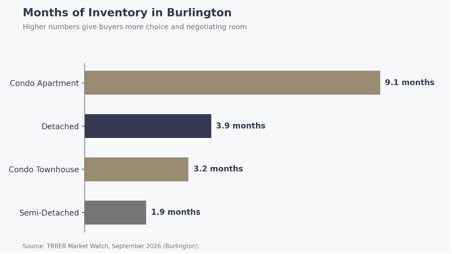
Today’s market gives downsizers a rare double advantage. First, detached homes in Burlington are holding their value. Detached prices sat at 3.9 months of inventory in September, which signals a steady, balanced market for sellers.
Second, buyers of condo apartments have plenty of choice. That segment showed 9.1 months of inventory, which gives buyers real room to negotiate. In other words, you can sell into a stable market and buy into a market that rewards patience.
This combination helps you protect more of your equity on both sides of the move. Still, every neighbourhood behaves differently. That is why a property-specific evaluation matters before you make any decisions.
Alt text: Equity planning chart comparing months of inventory by home type in Burlington, September 2026
The Equity Math: A $1.7 Million Example
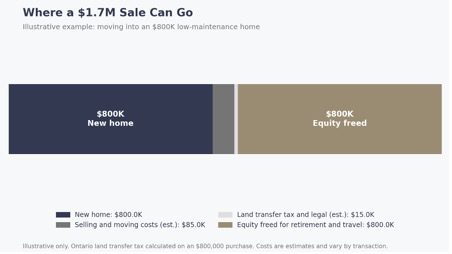
Let’s look at a simple example. Imagine you sell your family home for $1,700,000. Then, you buy an $800,000 low-maintenance home with no mortgage.
Next, you account for the costs of the move. These include estimated selling and moving costs, Ontario land transfer tax on your new home and legal fees. Burlington and Oakville do not charge a separate municipal land transfer tax, which keeps closing costs lower than in Toronto.
After those costs, you could free up roughly $800,000 in equity. That is money you can invest, spend on travel, share with your children or set aside for future care.
Alt text: Equity breakdown of a $1.7 million home sale into an $800,000 new home, costs and freed equity
Your numbers will differ, of course. Sale price, purchase price and timing all change the result. However, the example shows how much financial freedom can sit inside a well-loved family home.
Choosing a Low-Maintenance Home That Fits Your Life
Downsizing does not mean giving up comfort. Instead, it means choosing a home that works for the life you want today. Fortunately, our area offers several excellent options.
- Boutique condos: Smaller buildings with elevators, security and true lock-and-leave convenience.
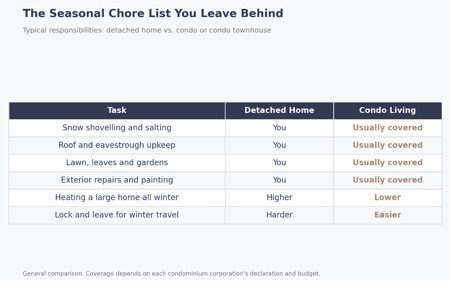
- Condo townhouses: Your own front door, with exterior care and snow removal typically handled for you.
- Bungalows and bungalow townhomes: Main-floor living that removes the daily climb up and down stairs.
Before you buy, look closely at monthly condo fees and what they cover. Also review the reserve fund and the building’s recent history. A strong building protects your equity for years to come.
Alt text: Equity and lifestyle comparison of seasonal chores in a detached home versus condo living
Investing the Difference for a Stronger Retirement
Once you free up equity, the next step is putting it to work. This is where a licensed financial advisor becomes an essential part of your team.
There is often a helpful tax advantage, too. If your home is your principal residence, the gain on its sale is generally exempt from capital gains tax in Canada. As a result, more of your equity stays in your pocket. Your advisor can confirm how this applies to you.
From there, an advisor can help you decide how to use registered accounts such as a TFSA, along with other investments. The goal is simple: build steady income that supports the retirement you want.
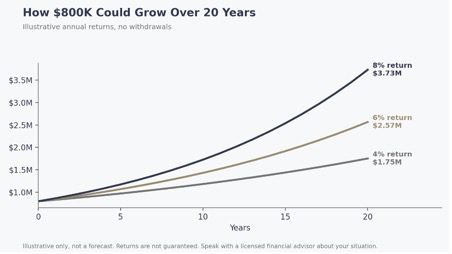
Alt text: Equity growth chart showing how $800,000 could grow over 20 years at 4, 6 and 8 percent returns
Your return depends on how you invest. For example, $800,000 growing at 4% a year could reach about $1.75 million in 20 years. At 6%, it could reach about $2.57 million. At 8%, it could reach about $3.73 million.
Keep in mind that higher returns usually come with higher risk. These figures are illustrative only and are not guaranteed. Your advisor can help you find the right balance between growth and peace of mind.
Funding Travel Without Second-Guessing Every Trip
For many of our clients, travel is the real dream. Perhaps it is a winter in Florida, a European river cruise or more visits to the grandchildren. Freed equity can turn those plans into a schedule.
Consider this example, using the middle 6% return. If $800,000 earns 6% a year and you withdraw $50,000 annually, the balance could last well beyond 30 years. At $60,000 a year, it could last about 28 years. At $70,000 a year, it could last about 20 years.
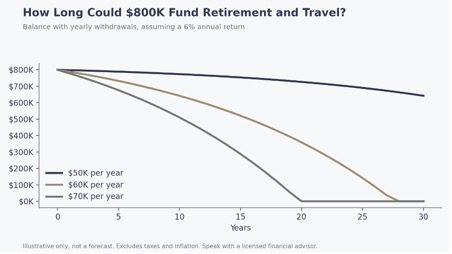
Alt text: Equity drawdown chart showing how long $800,000 could fund yearly retirement and travel withdrawals at a 6 percent return
Additionally, a lock-and-leave home makes travel far easier. There is no lawn to arrange, no driveway to clear and fewer worries about a large empty house over the winter.
Helping Your Children Buy Their First Home
For many downsizers, the most meaningful use of their equity is family. Today, saving for a down payment is a real challenge for young buyers. As a result, more parents are choosing to help now rather than leave an inheritance later.
Many families call this a living inheritance. You get to see your gift make a difference while you are here to enjoy it. Plus, your children can start building their own equity years sooner.
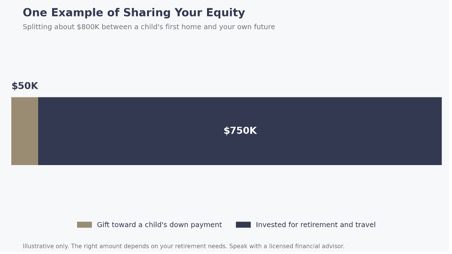
Alt text: Equity split example showing a gift toward a child’s down payment and the remainder invested for retirement
Here is a simple example. A $50,000 gift, combined with a child’s own savings, can bring a first home within reach sooner. Meanwhile, the remaining $750,000 stays invested for your retirement and travel. If your child’s total down payment reaches 20% or more, they can also avoid mortgage default insurance.
Smart Ways to Structure Your Help
- A gifted down payment: Canada does not have a gift tax. However, lenders will ask for a signed gift letter confirming the money does not need to be repaid.
- Help funding their FHSA: Your child can contribute up to $8,000 a year to a First Home Savings Account, to a lifetime limit of $40,000. A gift can help them fill it faster.
- Co-signing or going on title: This can help your child qualify, but it carries real risks and responsibilities. Discuss it carefully with a lawyer first.
Above all, protect your own retirement first. Your financial advisor can show you how much you can comfortably share. That way, helping your children never puts your own future at risk.
Best of all, we can help both generations at once. While we sell your family home and find your next one, we can also guide your children through their first purchase.
Sell First or Buy First?
This is one of the biggest decisions in any downsizing move. Each path has clear trade-offs.
- Selling first locks in your equity and gives you a firm budget. However, you may need flexible closing dates or a short-term rental.
- Buying first secures the home you love. On the other hand, you may need bridge financing until your current home sells.
We help you weigh both options against your timeline, finances and comfort level. Then, we coordinate closing dates so the move feels smooth rather than stressful.
List This Winter or Prepare for Spring?
You do not have to move before the snow flies to benefit from planning now. In fact, there are two smart approaches.
Listing in late fall or winter often means less competition from other sellers. The buyers who are active tend to be serious and motivated. Meanwhile, preparing over the winter for a spring launch gives you time to declutter, complete small repairs and plan your next home without pressure.
Either way, the planning starts with a conversation. We can map out both timelines and help you choose the one that protects your equity best.
How Urban Group Realty Helps Every Step of the Way
Downsizing is more than a transaction. It is a major life transition, and it deserves a team that treats it that way. Led by Ryan and Vicky Urban, Urban Group Realty has guided many families across Burlington, Oakville and Hamilton through this exact move.
Here is how we support you:
- A clear equity picture: We start with a detailed home evaluation, so you know what your home is worth in today’s market.
- Pricing and marketing that maximize your sale: Our strategy, staging guidance and premium marketing help your home stand out to the right buyers.
- The right next home: We search condos, townhomes and bungalows that match your lifestyle, budget and long-term needs.
- Support for the next generation: We help your children find and buy their first home, often alongside your own move.
- Careful timing: We coordinate both closings, so you are never rushed or stuck between homes.
- A trusted network: We can introduce you to mortgage specialists, real estate lawyers, movers and financial professionals who understand downsizers.
As a team recognized among the top 1% in Canada, we bring proven experience to every step. More importantly, we listen first. Your goals shape the plan, not the other way around.
Ready to See What Your Equity Could Do?
Another winter in a large home is optional. With the right plan, you can trade chores for freedom, strengthen your retirement, book those trips and help your family take their first step.
Start with a free, no-pressure conversation. Book a home evaluation or book a seller’s consultation. You can also visit urbangroup.com or call us at 905.673.1032.
Frequently Asked Questions
There is no single number. However, many local homeowners have substantial equity after decades of ownership. A home evaluation and a conversation with a financial advisor will show what is realistic for you.
If the home is your principal residence, the gain is generally exempt from capital gains tax in Canada. That said, rules have specific conditions. Always confirm your situation with an accountant or financial advisor.
It can be. Winter often brings fewer competing listings and more motivated buyers. Alternatively, you can use the winter to prepare for a spring listing.
Yes. Many downsizers gift part of their equity toward a child’s down payment. Lenders will require a signed gift letter. Speak with a financial advisor first, so your gift fits comfortably within your retirement plan.
For many downsizers, yes. Fees typically cover costs you already pay as a homeowner, such as exterior repairs, snow removal and landscaping. Review each building’s fees, budget and reserve fund before you buy.
It depends on your finances and comfort with risk. Selling first locks in your equity, while buying first secures your next home. Our team can help you compare both paths.
You May Also Like
If you found this article helpful, you’ll love these other insights from our blog:
- From Downsizing to Rightsizing: Luxury Low-Maintenance Homes You’ll Love
- How Should You Prepare Your Home for a Successful Downsize in Ontario?
- What Downsizing Mistakes Should You Avoid in Ontario?
This article is for general information only and is not financial, tax or legal advice. Examples are illustrative. Please consult a licensed professional about your situation.

Get The Newsletter
Join our mailing list to get updates from our experts about the Toronto market, the latest listings, and our industry insights.