

October 2, 2026 | Real Estate Advice
Your Home Has Been Working for You: How Much Equity Have You Built?

Here is some good news for homeowners. While you have been busy living your life, your home has been quietly building wealth for you.
For many long-term owners in Southern Ontario, home equity is now their single biggest asset. Yet many people have no idea how much they actually have.
In this guide, the Urban Group Realty team explains how it grows. We also share how to estimate yours and what it can open up.
What Is Home Equity?
Home equity is the portion of your home that you truly own. Put simply, it is your home’s current market value minus what you still owe on your mortgage.
For example, imagine your home is worth $1,500,000. If your mortgage balance is $300,000, your equity is $1,200,000.
That is real value. You can access it when you sell, and in some cases, you can borrow against it.
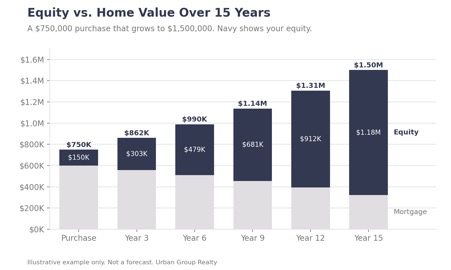
The chart above follows one illustrative home over 15 years. The navy portion is equity. Notice how it grows from both directions. The mortgage shrinks while the home’s value climbs.
Two Ways Your Equity Grows
It grows in two main ways, and both work in your favour over time.
1. Paying Down Your Mortgage
Every mortgage payment includes principal. Each time you pay it down, you own a larger share of your home. In the early years, more of each payment goes to interest. Over time, however, more goes toward principal, so your equity builds faster.
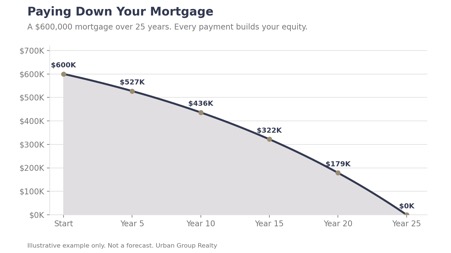
In this example, a $600,000 mortgage at 4.5% drops to about $322,000 after 15 years. That is roughly $278,000 in equity built through regular payments alone.
2. Rising Home Values
The second driver is appreciation. When your home’s market value rises, your share of it rises too. You do not have to do anything extra to benefit.
Markets move up and down in the short term. Over the long term, though, homeowners in desirable communities have historically been well rewarded.
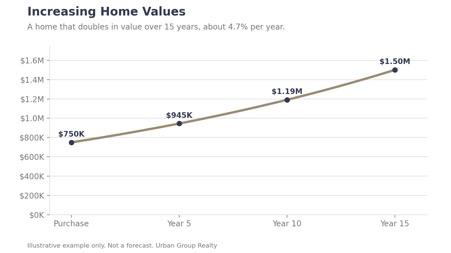
Here, a $750,000 home grows to $1,500,000 over 15 years. That works out to about 4.7% per year, and it adds $750,000 in equity.
Why Burlington and Oakville Homeowners Are Well Positioned
Burlington and Oakville have many of the qualities that support long-term home values. Buyers continue to seek them out, year after year.
- Beautiful waterfront living along Lake Ontario.
- Highly rated schools and family-friendly neighbourhoods.
- Easy access to Toronto by GO Transit and the QEW.
- Mature, tree-lined streets and limited land for new detached homes.
- Parks, trails and the Niagara Escarpment close to home.
As a result, many owners who bought ten or more years ago have built substantial wealth. For some, it is far more than they expected.
How to Estimate Your Equity
You can get a rough estimate in three simple steps.
- Step 1: Estimate your home’s current market value.
- Step 2: Check your latest mortgage statement for your remaining balance. Include any home equity line of credit.
- Step 3: Subtract your balance from your home’s value.
Let’s put it all together with an illustrative example. Say you bought a home for $750,000 with $150,000 down. You took out a $600,000 mortgage. Fifteen years later, your home is worth $1,500,000, and you owe about $322,000. You would have roughly $1,178,000 in equity.
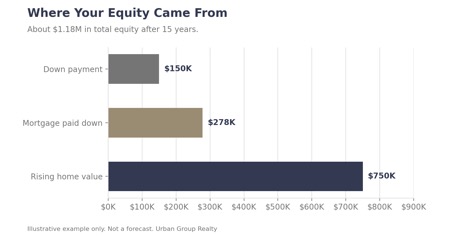
As the chart shows, rising home values did most of the heavy lifting. Your regular payments added a strong boost too.
Keep in mind that step one is the tricky part. Online estimates often miss key details, such as renovations, lot size and your exact street. A professional home evaluation gives you a far more accurate number.
What Your Equity Can Help You Do
This is where it gets exciting. Your equity can open doors that may not have seemed possible before.
Move Up to Your Dream Home
Growing family? Need a home office or a bigger backyard? It can become a strong down payment on your next home.
Rightsize for Your Next Chapter
For empty nesters, it can fund a move to a low-maintenance home. In many cases, it can also free up money for travel, family or retirement.
Help Your Children Buy Their First Home
Many parents in our region are using this wealth to help their kids buy sooner.
Renovate and Add Value
Some owners choose to stay and upgrade. Smart renovations can improve your lifestyle and boost your home’s value at the same time.
Invest in Your Future
Others use it to buy an investment property or add a secondary unit. Either way, your home helps you build even more wealth.
If you are thinking about borrowing against your equity, speak with a mortgage professional first. They can walk you through the options and costs.
Find Out Your Number
Knowing your equity puts you in control. Whether you plan to move next year or simply want peace of mind, it is worth knowing where you stand.
The Urban Group Realty team knows Burlington, Oakville and Hamilton street by street. We can give you an accurate picture of your home’s value and what it could do for you.
Book your home evaluation today at urbangroup.com/book-home-evaluation, or call us at 905.673.1032. Your home has been working hard for you. Let’s see what it has built.
Frequently asked questions
It is your home’s current market value minus your mortgage balance. Include any other loans secured by the home.
Subtract your mortgage balance from your home’s market value. For an accurate value, book a professional home evaluation.
Equity grows as you pay down your mortgage principal and as your home’s market value rises over time.
In many cases, yes. Options like refinancing or a home equity line of credit may be available. A mortgage professional can explain what fits your situation.
They can be a starting point, but they often miss renovations, lot size and location details. A local expert will give you a more reliable number.
You May Also Like
- From Downsizing to Rightsizing: Luxury Low-Maintenance Homes You’ll Love
- The ROI Playbook: Smart Upgrades That Boost Home Value
- Life-Changing Transition? How to Move in Today’s Interest Rate Marke
Get The Newsletter
Join our mailing list to get updates from our experts about the Toronto market, the latest listings, and our industry insights.