
August 27, 2026 | Market Reports
Burlington, Oakville and Hamilton: 2026 Year-to-Date Review, 2025 Comparison and What Comes Next

With eight months of 2026 behind us, it is a good moment to step back and look at how the Burlington, Oakville and Hamilton real estate market has actually performed this year, how that compares to 2025, and where things are likely headed for the rest of 2026. Ryan and Vicky Urban and the Urban Group Realty team break down all three angles in one place.
Part One: The 2026 Year So Far
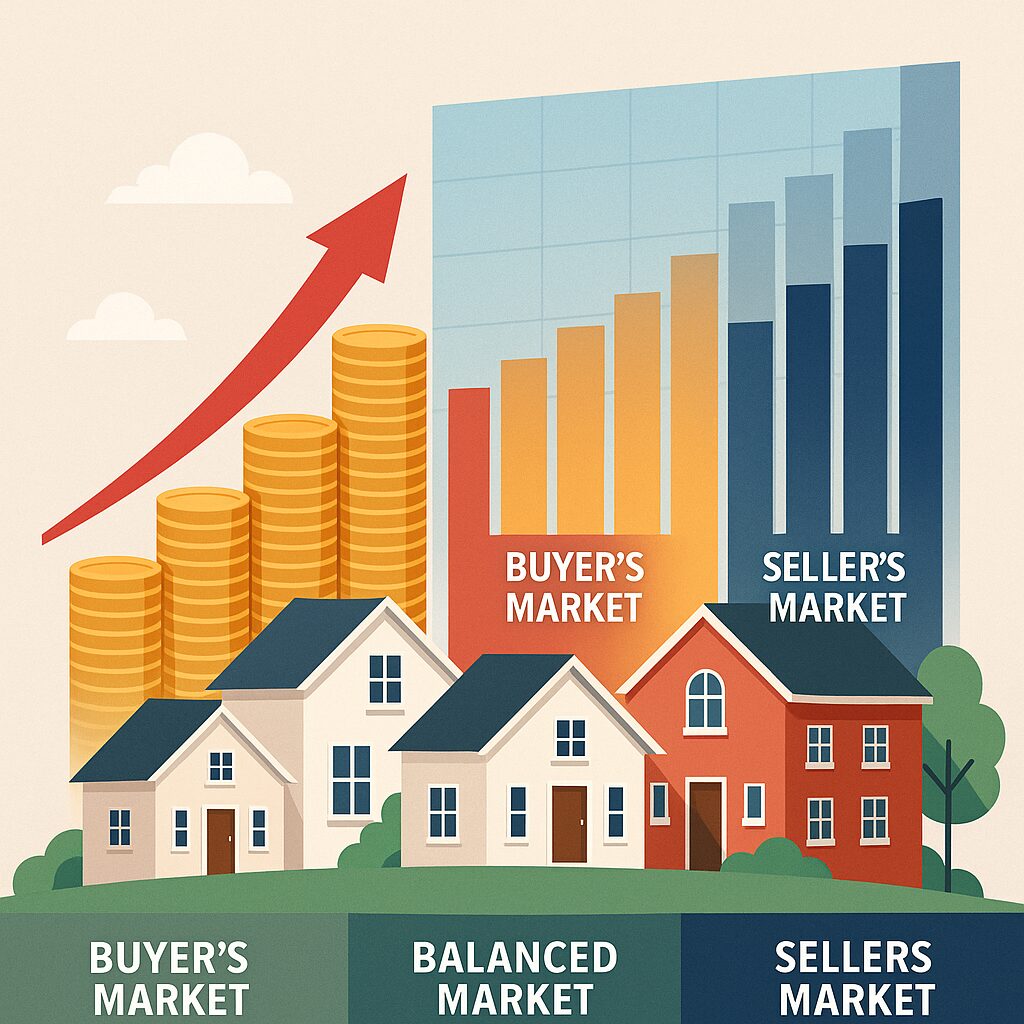
The Bank of Canada held its policy rate at 2.3% through the summer, its sixth consecutive hold as of July, giving buyers and sellers a stable borrowing environment for the first extended stretch in several years. That stability has shaped the entire year: rather than sharp swings, 2026 has been defined by a gradual shift from the seller-driven conditions of prior years toward a genuinely balanced market.
Across the wider Hamilton-Burlington-Haldimand-Niagara North region tracked by the Cornerstone Association of REALTORS, sales activity through the summer months has consistently trailed 2025 on a year-over-year basis, even as month-over-month figures showed steady improvement since the start of the year. July alone saw an 11.0% year-over-year decline in sales, with the MLS Home Price Index sitting at $729,800, down 4.9% from a year earlier.

Burlington: Softer Prices, Steady Demand
Burlington enters late summer down 9.4% year to date on price, and 1.5% year over year, with an average listing price of $1,329,000. Despite the softer headline number, absorption rates tell a healthier story underneath: detached homes are absorbing at 37.2% and freehold townhomes at 43.6%, both squarely in balanced territory. Condos and apartments have actually posted price growth of 2.5% this year, the strongest performing segment in the city.
Oakville: Sales Volume Surges Even as Prices Soften
Oakville has had an unusual year-to-date pattern: sales are up 32.6% year over year and new listings are up 41.0%, yet average price is down 7.6% and median price down 3.2%. Far more transactions are happening, but at more moderate price points than a year ago. The detached segment continues to hold 6.1 months of inventory, unchanged from July, keeping conditions balanced heading into fall.
Hamilton: Affordability Continues to Draw Buyers
Hamilton’s year-to-date story is one of gradual price softening paired with resilient demand. The benchmark price of $729,800 in July was down 4.9% year over year, and Hamilton’s relative affordability compared to Burlington and Oakville continues to draw buyers priced out of pricier markets, particularly those relocating from Toronto. Inventory sits at 4.7 months of supply, keeping the market balanced rather than tipping toward buyers or sellers.
Part Two: How 2026 Compares to 2025
2025 was a difficult year across the Hamilton-Burlington region. Sales in the first half of 2025 were running as much as 20.0% below the prior year at points, marking the slowest start to a year since 2010, and the average residential price across the wider Hamilton-Burlington area finished 2025 at $783,254, down 3.0% from $810,074 in 2024. By contrast, 2026 has been a year of stabilization rather than further decline: month-over-month sales gains have been steadier, rate holds from the Bank of Canada have supported buyer confidence, and industry forecasts pointed to roughly 2.0% price growth and 3.0% sales growth for the region heading into the year.

Burlington’s price trajectory has continued to soften through both years, but the pace has moderated. Where 2025 saw persistent year-over-year declines driven by high inventory and cautious buyers, 2026 has shown absorption rates recovering to balanced territory, particularly for detached homes and freehold townhomes.
Oakville shows the sharpest turnaround of the three cities. Sales activity is up 32.6% year over year heading into fall 2026, a dramatic reversal from the subdued conditions of 2025 when high borrowing costs kept many buyers on the sidelines.
Hamilton followed the broader regional pattern in 2025, with sales down and prices under pressure from elevated inventory. In 2026, Hamilton’s price declines have moderated to 4.9% year over year as of July, compared to steeper drops earlier in the down cycle, and months of supply have settled at a more balanced 4.7 months.
What changed between the two years comes down to three things: interest rate stability, as the Bank of Canada’s repeated holds through 2026 replaced the uncertainty that weighed on 2025 buyer decisions; inventory normalization, as elevated 2025 listings have been gradually absorbed; and buyer confidence, as steadier monthly sales gains throughout 2026 suggest buyers who sat out 2025 are re-entering the market.
Part Three: What to Expect for the Rest of 2026
Industry forecasts heading into 2026 projected average residential prices across the wider Hamilton-Burlington market area to rise roughly 2.0% compared to 2025, with sales volume climbing approximately 3.0%. So far, that trajectory has largely held: rate stability from the Bank of Canada has supported a gradual firming of demand, even as individual cities continue to show softer year-over-year pricing in specific segments.

Burlington is projected to see price growth in the 2 to 4% range for the rest of 2026, assuming borrowing costs continue to moderate and supply does not surge unexpectedly. Strong neighbourhoods such as Millcroft, The Orchards and waterfront-adjacent areas are likely to outperform this range, while entry-level segments may see more modest, flatter movement.
Oakville’s forecast is more modest at 1 to 3%, prioritizing location, upgraded homes and overall quality over broad market momentum. Given Oakville’s scarcity of premium detached lots and roughly 90.0% price appreciation over the past decade, the city’s long-term trajectory remains upward even where near-term growth looks conservative.
Hamilton carries the strongest projected growth range of the three cities at 3 to 5%, driven largely by first-time buyers and move-up purchasers taking advantage of relative affordability. Growth is likely to be uneven across neighbourhoods, with areas like Rural Glanbrook and Watertown West positioned to outperform the city average.
Two factors stand out as the biggest swing variables for the rest of 2026. First, any further move by the Bank of Canada, whether a rate cut or an unexpected hold reversal, would shift buyer borrowing power and confidence quickly. Second, the pace of new listings matters just as much as buyer demand: if supply surges faster than absorption, price growth projections could soften, particularly in the condo and entry-level segments across all three cities.
What This Means for You
If the forecasted growth holds, waiting further into 2026 or into 2027 could mean paying more for comparable homes, particularly in Hamilton where the growth range is steepest. Buyers who are pre-approved and ready to act have an advantage in a market that is gradually firming rather than sitting flat. Sellers benefit from understanding that growth, where it happens, is likely to be concentrated in specific neighbourhoods and property types rather than spread evenly, so pricing based on hyper-local comparables matters more than ever.
Talk to a Local Market Expert
Ryan and Vicky Urban and the Urban Group Realty team track these numbers all year long so you do not have to. Visit urbangroup.com or call 905.673.1032 for a personalized read on your neighbourhood.
Frequently Asked Questions
The market has shifted from seller-driven conditions to a balanced environment, with softer prices in most segments but healthier absorption rates and, in Oakville’s case, a significant rise in sales volume.
Yes, overall. 2026 has brought more rate stability and steadier month-over-month sales activity compared to the sharp declines seen through much of 2025.
Forecasts point to modest growth in all three cities, ranging from 1 to 3% in Oakville up to 3 to 5% in Hamilton, assuming rates remain stable.
Hamilton carries the strongest projected range at 3 to 5%, while Oakville has already shown the sharpest turnaround in sales volume, up 32.6% year over year.
Waiting carries its own risk. If forecasted growth holds, comparable homes are likely to cost more later in the year or into 2027 than they do today.
You May Also Like
- Burlington Market Update: July 2026
- Oakville Market Update: July 2026
- Hamilton Market Update: July 2026
Get The Newsletter
Join our mailing list to get updates from our experts about the Toronto market, the latest listings, and our industry insights.